Autonomous Networks levels solution packs

Proven AN solutions
The journey towards network autonomy involves complex coordination across diverse networks, platforms, and systems from various vendors.
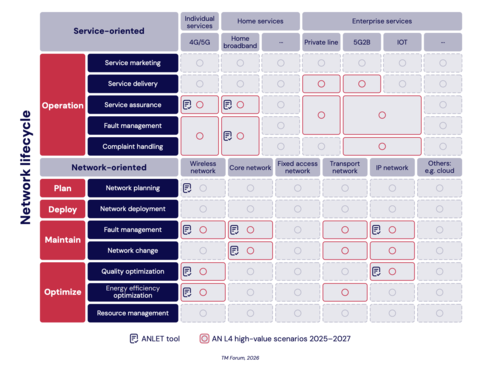
TM Forum's Autonomous networks project brought our members together to develop a comprehensive overview of the highest priority AN solutions for CSPs that establishes a clear set of AN objectives.
The AN high value scenarios guide aims to direct the industry into which AN solutions to prioritize and how to develop them; it outlines the scope and sequence of AN planning and deployment. It serves as a navigation 'map' for operators on their AN journey and, as AN matures, it will act as a reference point for promoting AN efforts and successes.

Solution packs for AN Level 4
However, there is a noticeable lack of effective guidance on how to rapidly establish these AN L4 solutions.
TM Forum's members have built / are building AN Level solution packs that are being developing across the matrix of domains and services needed for the CSPs to deliver autonomous networks.
The solution packs will act as a template for the implementation of high-value scenario; including scenario descriptions, the AN L4 objectives and key features, the effectiveness key metrics from both business (KBI) and technical (KPI) perspective, the required architecture, and interaction processes.
They will serve as a case-based reference for CSPs, reducing users’ learning costs associated with developing and deploying AN L4 standards.
AN Solution Packs
The TM Forum Autonomous Networks (AN) Project has established a series of standards, including glossaries (such as IG1258), reference architectures (like IG1251), metric systems (IG1256), high-value scenario grading standards (IG1339), and assessment tools (IG1252 & GB1059). To assist users in quickly starting their AN Level 4 journey without needing extensive knowledge of the TM Forum AN standards and their background, the IG1500 series of documents provides instantiated descriptions that connect TM Forum Autonomous Networks standards, allowing users to intuitively understand the application and deployment of AN standards in real business scenarios.
This package focuses on the Individual services (4G/5G) scenario. It captures how operators can assure performance, linking service intent with awareness, analysis, decision, and execution. It outlines the L4 objectives, key features, metrics, and reference architecture, serving as a concrete guide for CSPs aiming to bridge standards with real deployments.
| Title (clickable) | Description |
AN L4 Individual services service assurance solution package (IG1503A) | This package focuses on the Individual services (4G/5G) scenario. It captures how operators can assure performance, linking service intent with awareness, analysis, decision, and execution. It outlines the L4 objectives, key features, metrics, and reference architecture, serving as a concrete guide for CSPs aiming to bridge standards with real deployments.
|
| AN L4 Home Broadband Service Assurance Solution Package (IG1503B) | This document defines the solution package for the Home Broadband (HBB) service assurance scenario, including scenario descriptions, AN L4 objectives and key features, effectiveness metrics used, architecture, and interaction processes. It serves as a case-based reference for CSPs, reducing users' learning costs associated with the AN L4 standards. |
| AN L4 Enterprise Private Line Service Assurance Solution Package (IG1503D) | This document presents the solution package for enterprise private line service assurance within the AN L4 framework. Using real optical network performance monitoring as examples, it outlines how to define effectiveness indicators, evolution goals, reference architecture, and workflows for the automation of enterprise private line SLA assurance under the AN L4 structure. Additionally, the document lists common optical network performance sub scenarios to provide readers with standardized solutions, facilitating a swift initiation of their AN L4 immigration journey. |
These solution packages are for service complaint handling within the AN L4 framework. They includes the common customer complaint scenarios, the effectiveness indicators, evolution goals, reference architecture, and interaction workflows for individual service complaint handling under the AN L4 structure.
Title (clickable) | Description |
This solution package is for individual service complaint handling within the AN L4 framework. It includes the common customer complaint scenarios, the effectiveness indicators, evolution goals, reference architecture, and interaction workflows for individual service complaint handling under the AN L4 structure |
Solution packs are designed to help deliver planning and design scenarios for different network domains (i.e., RAN, CORE, IP & Transport, etc.). These solution packs provide network planning and design scenarios, including scenario descriptions, AN L4 objectives and key features, effectiveness metrics used, architecture, and interaction processes for each domain.
Title (clickable) | Description |
This document defines the solution package for the fixed access network planning and design scenario, including scenario descriptions, AN L4 objectives and key features, effectiveness metrics used, architecture, and interaction processes. It serves as a case-based reference for CSPs, reducing users’ learning costs associated with the AN L4 standards. |
These document define a standard solution package for AN L4 fault management scenarios, which describes end-to-end how network fault can automatic handling. This includes fault detection at the network element layer, automatic handling of network faults at the resource layer, event reporting, management of cross-domain fault proxies at the business layer, coordination across autonomous domains, involvement of operational personnel, and natural language repair guidance. This comprehensive approach ensures effective management of network faults.
| Title (Clickable) | Description |
This document presents the solution package for Mobile Network Fault Management within the AN L4 framework. Using real mobile network faults as examples, it outlines how to define effectiveness indicators, evolution goals, reference architecture, and workflows for mobile network fault management under the AN L4 structure. | |
AN L4 Core Network Fault Management Solution Package v1.1.0 (IG1523B)* | This document presents the solution package for Core Network Fault Management within the AN L4 framework. Using real Core Network faults as examples, it outlines how to define effectiveness indicators, evolution goals, reference architecture, and workflows for Core Network fault management under the AN L4 structure. |
AN L4 Transport Network Fault Management Solution Package v1.0.0 (IG1523D)* | This document presents the solution package for Transport Network Fault Management within the AN L4 framework. Using real Transport Network faults as examples, it outlines how to define effectiveness indicators, evolution goals, reference architecture, and workflows for Transport Network fault management under the AN L4 structure. |
AN L4 IP Network Fault Management Solution Package v1.1.0 (IG1523E)* | This document focuses exclusively on single-domain faults within the AN L4 IP Network. It adheres to a specific fault classification methodology and outlines the evolution goals for AN L4, as well as its key features. Additionally, the integration modes of copilot/agent are discussed, along with cross-domain fault management strategies. For detailed reference and guidelines, readers are encouraged to consult IG1501 |
*these are at Beta level of maturity and as such may change when they become GA ready. If you wish to work on improving them, please join the AN Project.
These documents define the solution packages for quality optimization in within various network domains, they include scenario descriptions, the AN L4 objectives and key features, the effectiveness metrics used, architecture, and interaction processes. They serve as a case-based reference for CSPs, reducing users’ learning costs associated with the AN L4 standards.
Title (clickable) | Description |
AN L4 IP Network Quality Optimization (IG1525E) | This document defines the solution package for quality optimization in IP network, including scenario descriptions, the AN L4 objectives and key features, the effectiveness metrics used, architecture, and interaction processes. This serves as a case-based reference for CSPs, reducing users’ learning costs associated with the AN L4 standards. |
These solution package are for energy efficiency optimization within the AN L4 framework. It includes effectiveness indicators, evolution goals, reference architecture, and end-to-end workflows for energy efficiency optimization scenario under the AN L4 structure.
Title (clickable) | Description |
This solution package is for wireless energy efficiency optimization within the AN L4 framework. It includes effectiveness indicators, evolution goals, reference architecture, and end-to-end workflows for wireless energy efficiency optimization scenario under the AN L4 structure. This document focuses on energy efficiency optimization for AN L4 wireless network. Additionally, the integration modes of agent for wireless energy efficiency optimization is proposed
|
Fast track your AN journey
Understand
Use our high-value scenarios (HVS) map to set clear transformation goals and translate them into practical, actionable steps.
Evaluate
Use our domain- and service-specific questionnaires (ANLET) to evaluate your network’s current level of autonomy across key business scenarios.
Validate
Confirm your evaluation results: AN Level Assessment Validation service (ANLAV), ensures correct use of the AN Levels Evaluation tools (ANLET) methodology
Implement
Use our solution packs to guide your transformation with proven CSP-led approaches across objectives, metrics, architecture, and processes.
Grow your impact
Shape future autonomous networks standards by joining our Autonomous Networks Collaboration Project.

Start your journey by selecting a HVS
Understand all the high value scenario (HVS) and select one that most supports your business needs.
ANLET and ANLAV
Autonomous Network Level Evaluation Tools (ANLET)
TM Forum’s Autonomous Networks Level Evaluation Tool (ANLET) defines a comprehensive methodology for applying the Autonomous Networks Level model. It details the structured approach, operational processes, their underlying sub-processes and tasks, as well as task evaluation criteria. Together, these elements establish a standardized and repeatable framework for objectively assessing the Autonomous Networks Level of an entire network or any of its constituent parts.
Autonomous Network Level Assessment Validations (ANLAV)
TM Forum’s Autonomous Networks Level Assessment Validation (ANLAV) service provides independent verification that an operator’s Autonomous Network Level assessment has been conducted accurately in accordance with TM Forum's defined methodology. It confirms that the standardized AN Level Evaluation Tools have been correctly applied and that the supporting evidence fully substantiates the stated AN Level score
Please contact [email protected] for more information about this service.
AN Levels are classified from Level 0 to Level 5, from manual management to fully Autonomous Networks. A general methodology for evaluating AN Levels is defined in the TM Forum standard IG1252.
AN Level evaluations for specific scenarios are carried out using standardized AN Level Evaluation Tools published as a series of spreadsheet-based questionnaires (see document series GB15xx). These are designed to help operators quickly identify weaknesses in their autonomous network capability and accelerate iterative autonomous network deployment.
Takes you from basic understanding of the methodology to the detailed implmentation and use of our guides, the KBI and KPIs to ensure you can evaluate a domain and technology within the AN framework
TM Forum provides the AN Levels Skill Path certification for professionals involved in assessing AN Levels. This certification recognizes competence in using the AN Levels Evaluation Tools and methodology. The table below shows companies with ANLAV Skill Path certified professionals who may be able to offer AN Level assessment services.
Introductory pricing (valid until the end of June 2026)
- Pricing is based on the complexity of the scenario being validated
Repeat validations
- A repeat validation is a second validation of the same network scenario in the same location with the same version of the same ANLET tool (typically after an automation project to measure the difference compared to the previous AN Level score)
- A 25% discount applies for a repeat validation when ordered together with the original validation
- A 15% discount applies for a repeat validation when ordered at a later date
- Repeat validations must be submitted within 6 months of the completion of the original validation
| Scenario | Price | ANLET |
| ANLAV - GB1503A - Service Assurance - Individual Services | $ 5,695 | GB1503A |
| ANLAV - GB1503B - Home Broadband Service Assurance | $ 4,960 | GB1503B |
| ANLAV - GB1504A - Individual Services Complaint Handling | $ 5,695 | GB1504A |
| ANLAV - GB1504B - Home Broadband Complaint Handling | $ 5,695 | GB1504B |
| ANLAV - GB1505A - Individual Service Fault Management | $ 4,960 | GB1505A |
| ANLAV - GB1521E - IP Network Planning | $ 4,960 | GB1521E |
| ANLAV - GB1523A - RAN Fault Management | $ 7,760 | GB1523A |
| ANLAV - GB1523B - Core Network Fault Management | $ 7,760 | GB1523B |
| ANLAV - GB1523D - Transport Network Fault Management | $ 7,760 | GB1523D |
| ANLAV - GB1523E - IP Network Fault Management | $ 7,760 | GB1523E |
| ANLAV - GB1524A - Wireless Network Change Management | $ 7,760 | GB1524A |
| ANLAV - GB1524B - Core Network Change Management | $ 5,695 | GB1524B |
| ANLAV - GB1525E - IP Network Quality Optimization | $ 5,695 | GB1525E |
| ANLAV - GB1526A - RAN Energy Efficiency Optimization | $ 5,695 | GB1526A |
See our table of AN Level validations for network operators who have agreed to share their results publicly. Many more operators are sharing the results of their AN Level assessments within the Autonomous Networks collaboration project, which is open for all TM Forum members to join.
Note 1 that the validation table does not certify that the network actually performs at the level claimed, which would require more detailed investigation and testing.
Note 2: AN Level Evaluation Tools at “alpha” quality may potentially be subject to significant changes before general availability.
Note 3: Validations labeled “partial” were undertaken with a subset of the sub scenarios specified in the AN Level Evaluation Tool.
Quick links
Find more resources that will enable you to evaluate your current AN implementations with our AN level questionnaires (ANLET), ANLET training courses to ensure you know how to use them.
For more detailed explanation then please go to our resources page.
ANLET questionnaires
The Autonomous Network Levels (ANL) are concepts jointly proposed by TM Forum and industry partners to evolve network infrastructure and operations systems using automation and intelligence. Systematic AN concepts, standards, implementation methods and application use cases have been defined, resulting in a resounding consensus on AN across the industry through the ANLET questionnaires.
Training pathway
If you are an CSP, vendor or even an independent consultant who wants to evaluate the current status of a CSPs AN solution then you need can take the AN levels evaluation certification.
Note: TM Forum only accepts evaluations for ANLAV from those that have taken the full AN Level certification path.
CSPs ANLAV results table
The following table shows AN Level validations for network operators who have agreed to share their results publicly. Many more operators are sharing the results of their AN Level assessments within the Autonomous Networks collaboration project, which is open for all TM Forum members to join.